Some posts on this site contain affiliate links, meaning if you book or buy something through one of these links, I may earn a small commission (at no extra cost to you!). You can read my full disclosure policy here.
No, the High Line isn’t a tightrope high above New York City. Well, sort of. If you have a great imagination, you could maybe see it. In reality, the High Line is a park built above the ground, on what was once the New York Central Railroad.
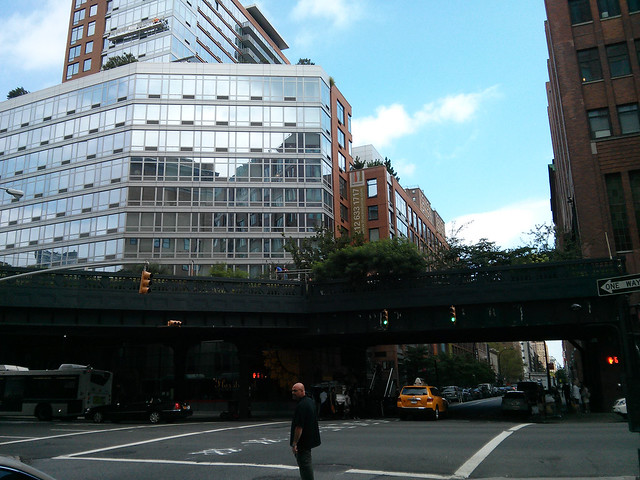
The railroad, originally on the ground level was responsible for many accidents, so much so that it was known as “Death Avenue.” To remedy the situation, the built the railroad above ground which allowed the trains, to stop directly inside these buildings and not disturb traffic on the street. The trains carried meat to the meatpacking district, agricultural goods to the factories and warehouses of the industrial West Side, and mail to the Post Office. The growth of trucks for transportation caused the railroad to become obsolete and the trains were removed in 1980.
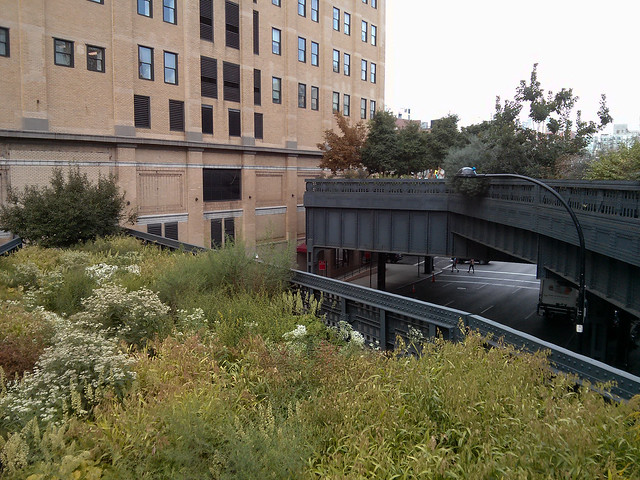 Under the threat of demolition, a coalition, Friends of the High Line, in cooperation the City of New York, formed to preserve the historical structure. Taking inspiration from Promenade Plantée in Paris, the structure was transformed in to a public space, an elevated public park for many to enjoy. And many indeed have enjoyed it. More than four million people visit each year, making it one of the city’s most visited public parks per acre. There was a constant ebb and flow while I was there with a lot of locals, and tourists, out to enjoy the park.
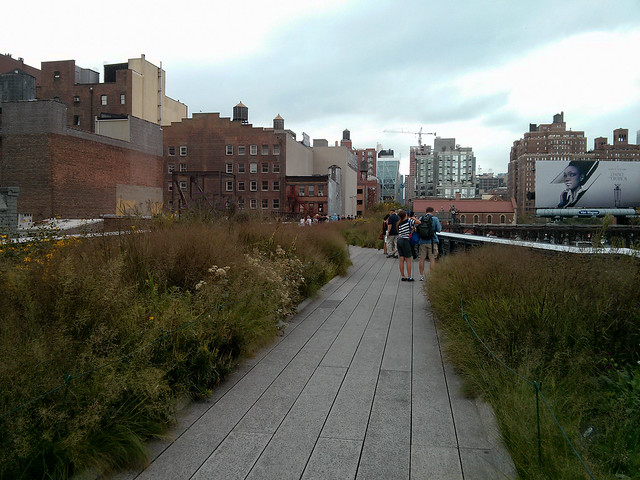 The High Line is located on Manhattan’s West Side. It runs from Gansevoort Street in the Meatpacking District to West 34th Street, between 10th and 11th Avenues.
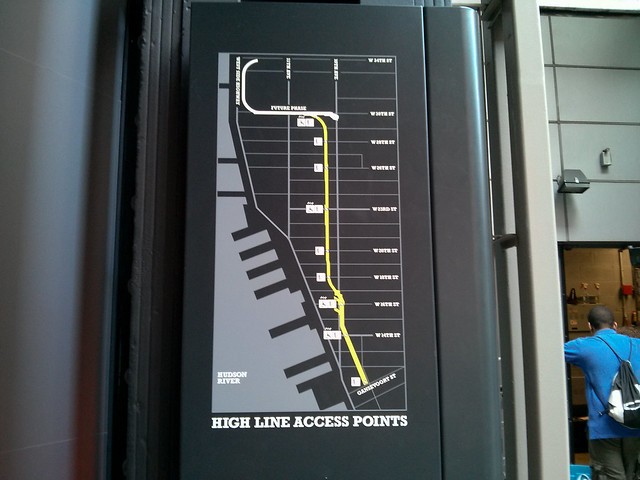 There are a number of access points to the park, but I went up from the point just outside of Chelsea Market on the corner of 10th Ave and West 16th. I missed it when I first walked out of the market as its not immediately obvious.
 Right at the point where I walked up, I spotted an amphitheatre with seating overlooking the street. There were lots of people relaxing, eating a meal or just chatting with friends or coworkers. I took a seat on a nearby bench and ate my lunch that I picked up from Chelsea Market.
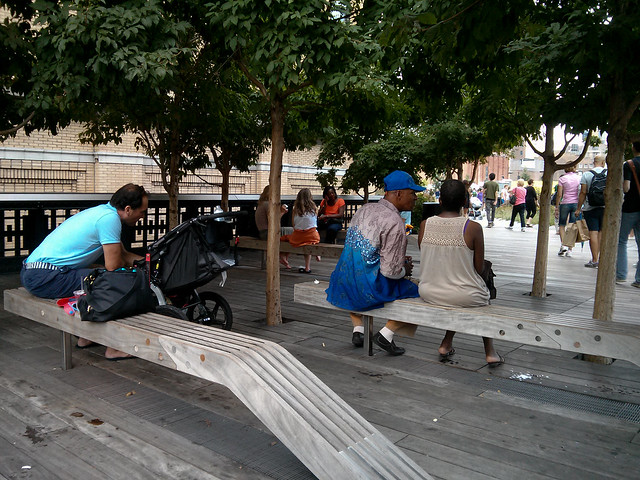
My lunch view
Hidden among the 300 species of perennials, grasses, shrubs, and trees are pieces of artwork. Some are hidden among the bushes and trees and others are placed in gathering places, each unique pieces. There was one piece that spoke to you if you walked close to it. It was funny to see people react to the sudden voice.
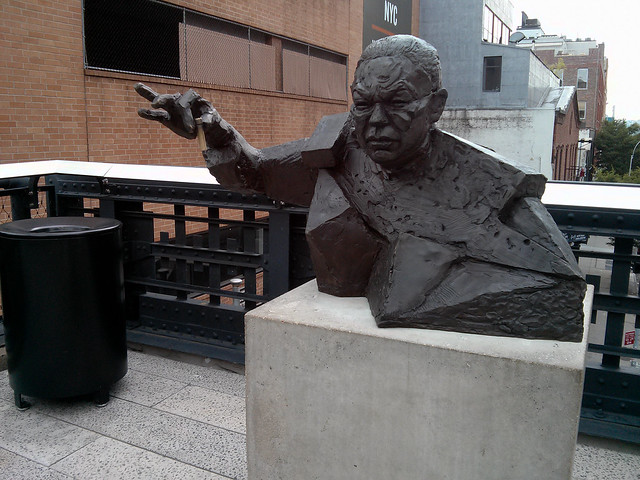
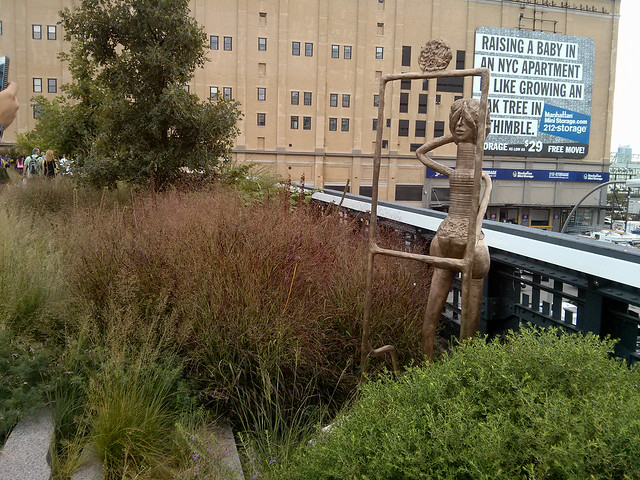 While not strictly for the High Line, this was my favourite thing I spotted from the pathway.
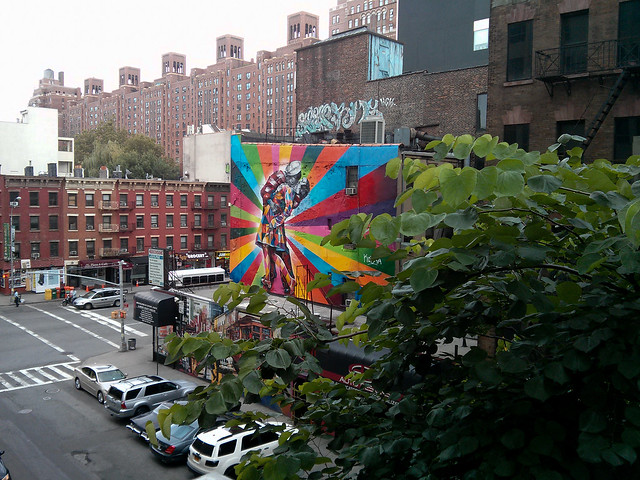
Taking a classic and spinning it on its head.
Today more than one-third of the High Line’s original rail tracks are featured in the park’s design. While strolling through the park, you can see remnants of the railroad. They’ve worked the tracks seamlessly into the pathway and the pathway into the plants and gardens. It all rolls from one into the other.
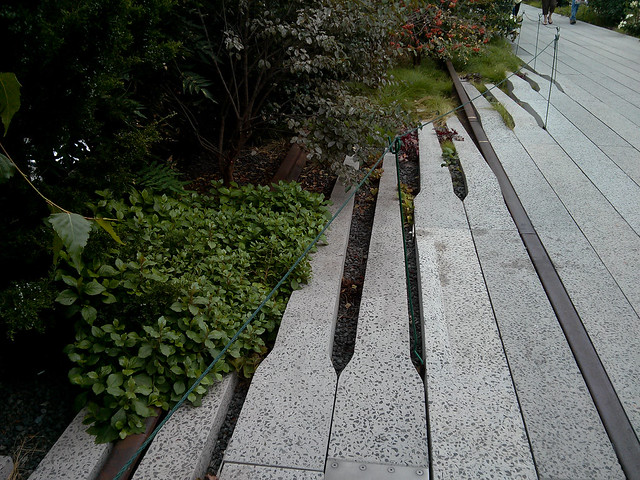
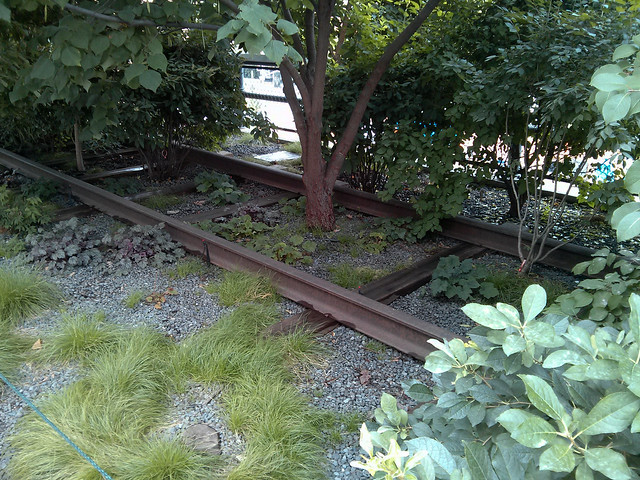 The plants used are inspired by what grew on unused rail tracks during the 25 years after trains stopped running. The species of perennials, grasses, shrubs and trees were chosen for their hardiness, sustainability, and textural and color variation, with a focus on native species.
 Throughout the park there were benches and gathering places for people to rest, eat and chat with friends. I could imagine myself laying in the grass here with a good book.

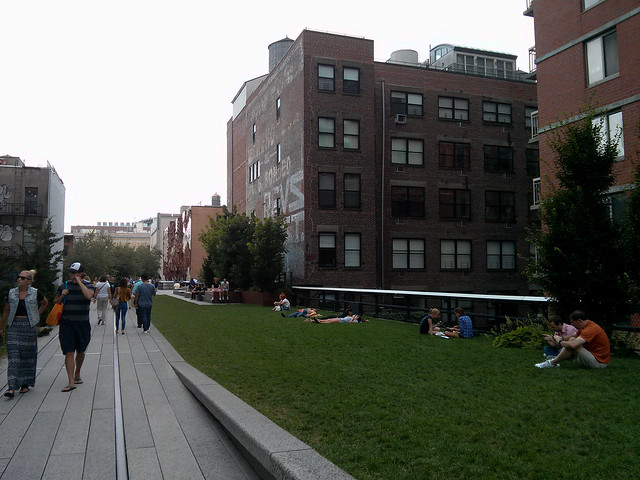 The High Line is built right up next to the buildings that line it. At times, you could almost peer into the neighboring buildings.
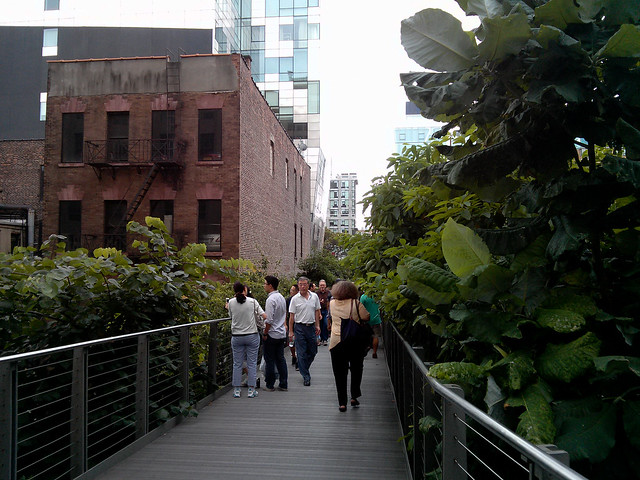 Beyond just re-purposing an unused section of the city, the park was built with sustainability in mind. The landscape uses similar technology to a green roof with multiple layers including a porous drainage layer, gravel, filter fabric, subsoil, and topsoil. The paths are designed to reduce storm water runoff and to reduce the amount of water brought in for the plants. Materials used in the High Line were selected based on life-cycle costs to reduce the need to replace and dispose of materials after a short time.
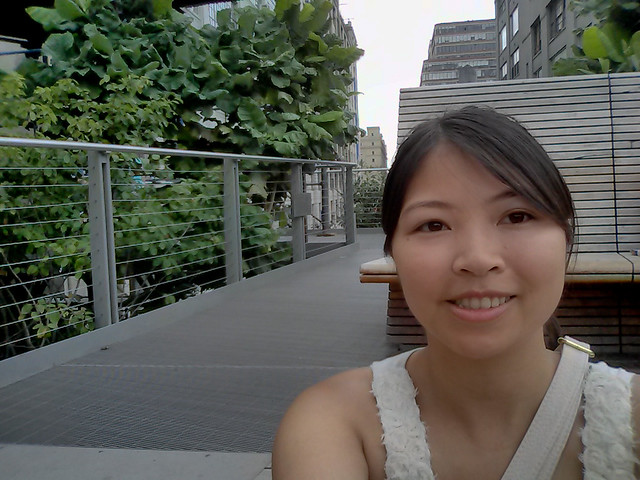
Despite the smile, this wanderer is pooped!
While I wanted to walk the length of the park, I was utterly exhausted and the heat and humidity were beating down on me. A journey for another time. What I did see of the park was very impressive and if I lived or worked in the area, I could see it being a place of refuge from all the cars and people of the city. It is a great place to go for a picnic lunch or break from being a tourist. I especially love the repurposed aspect of the whole park. It gives new life to the history of the city and is something that I would love to see adopted in other cities around the world.
Update 11/16/13: They’re expanding the High Line! Check out some artist renders. Looks cool! Hopefully it’ll be open the next time I’m in New York.
Have you been to the High Line? What did you think?
If you’re new to Pack Me To, welcome!
Stay on top of the fun by liking me on Facebook and following me on Twitter & Instagram.Subscribe on Bloglovin’!
Great post and pics! I visited the High Line in December and it was too cold to really enjoy it (but it looks like it was too HOT for you to enjoy it!) It’s probably a much better experience in nice weather.
Thanks Melissa! Yea, it definitely was too hot to be outside for too long! I want to go back when things are more temperate 🙂
It’s probably weird, but this has just moved NY up on my list of places I’d quite like to visit. What a great idea, and how well they’ve executed it.
I just love how they were able to reuse an area that otherwise would have been destroyed!